
Electronics & Communication Engineering
From silicon to signals — the backbone of modern communication.
ECE
Programme
180 seats
Sanctioned Intake
VLSI · Embedded · Comm.
Domains
Founding department
Heritage
About the Department
One of the founding departments, ECE has trained generations of engineers for the electronics, telecom, semiconductor and embedded-systems industries.
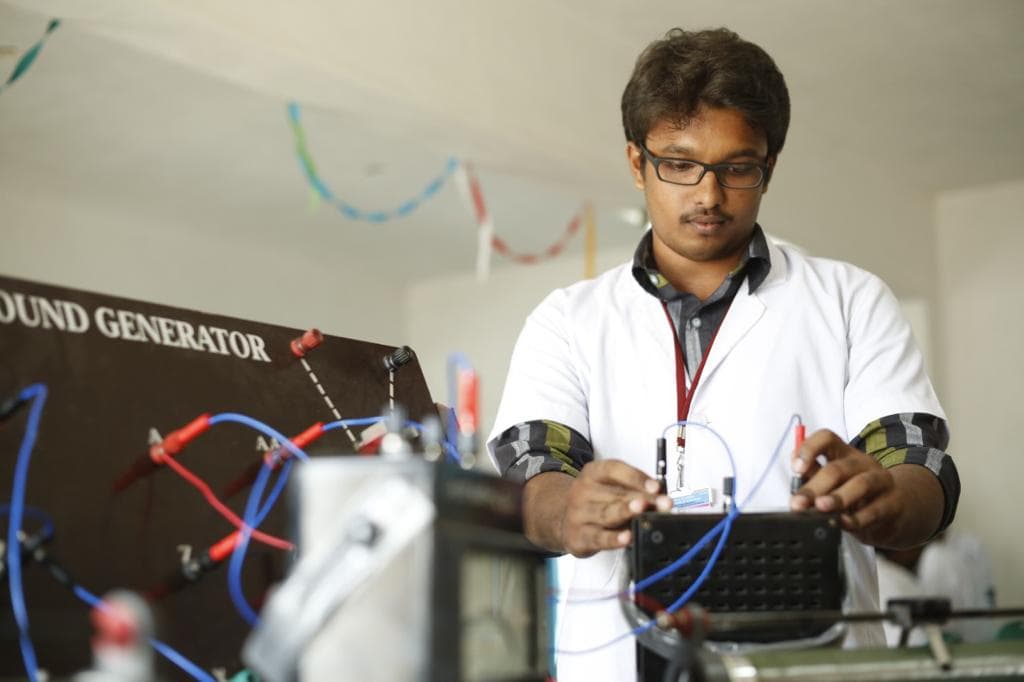
Laboratories cover analog and digital electronics, communication systems, microprocessors, VLSI design and embedded systems, equipped with contemporary instrumentation.
The department maintains active links with the core-electronics and IT sectors, opening both hardware and software career paths.
Vision
To become a center of excellence in Electronics and Communication Engineering and provide necessary skills to the students to meet the challenges in industry and society.
Mission
- 01
Provide congenial academic ambience with necessary infrastructure and learning resources.
- 02
Inculcate confidence to face and experience new challenges from industry and society.
- 03
Ignite the students to acquire self-reliance in State-of-the-Art Technologies.
- 04
Foster enterprising spirit among students.
Programmes Offered
- Electronics & Communication Engineering180 seats
Total sanctioned intake: 180
PEO's, PSO's & PO's
Program Educational Objectives (PEOs)
PEO1
Have professional competency through the application of knowledge gained from subjects like Mathematics, Physics, Chemistry, Inter-Disciplinary and core subjects like Signal Processing, VLSI, Embedded Systems, Communication and Automation. (Professional Competency)
PEO2
Excel in one's career by critical thinking towards successful services and growth of the organization or as an entrepreneur or through higher studies. (Successful Career Goals)
PEO3
Enhance knowledge by updating advanced technological concepts for facing the rapidly changing world and contribute to society through innovation and creativity. (Continuing Education and Contribution to Society)
Program Specific Outcomes (PSOs)
PSO1
Apply the knowledge obtained in core areas for the analysis and design of components in Signal Processing, VLSI, Embedded Systems, Communication and Automation.
PSO2
Adapt Innovation, Creativity and design to develop products which meet the industrial and societal needs.
Program Outcomes (POs)
Engineering knowledge: Apply the knowledge of mathematics, science, engineering fundamentals, and an engineering specialization to the solution of complex engineering problems.
Problem analysis: Identify, formulate, review research literature, and analyze complex engineering problems reaching substantiated conclusions using first principles of mathematics, natural sciences, and engineering sciences.
Design/development of solutions: Design solutions for complex engineering problems and design system components or processes that meet the specified needs with appropriate consideration for the public health and safety, and the cultural, societal, and environmental considerations.
Conduct investigations of complex problems: Use research-based knowledge and research methods including design of experiments, analysis and interpretation of data, and synthesis of the information to provide valid conclusions.
Modern tool usage: Create, select, and apply appropriate techniques, resources, and modern engineering and IT tools including prediction and modeling to complex engineering activities with an understanding of the limitations.
The engineer and society: Apply reasoning informed by the contextual knowledge to assess societal, health, safety, legal and cultural issues and the consequent responsibilities relevant to the professional engineering practice.
Environment and sustainability: Understand the impact of the professional engineering solutions in societal and environmental contexts, and demonstrate the knowledge of, and need for sustainable development.
Ethics: Apply ethical principles and commit to professional ethics and responsibilities and norms of the engineering practice.
Individual and team work: Function effectively as an individual, and as a member or leader in diverse teams, and in multidisciplinary settings.
Communication: Communicate effectively on complex engineering activities with the engineering community and with society at large, such as, being able to comprehend and write effective reports and design documentation, make effective presentations, and give and receive clear instructions.
Project management and finance: Demonstrate knowledge and understanding of the engineering and management principles and apply these to one's own work, as a member and leader in a team, to manage projects and in multidisciplinary environments.
Life-long learning: Recognize the need for, and have the preparation and ability to engage in independent and life-long learning in the broadest context of technological change.
Regulation and Syllabus
The department follows the JNTUA outcome-based curriculum, periodically revised by the Curriculum Development Cell in line with AICTE and NBA guidelines.
Regulation documents and the detailed semester-wise syllabus are available from the department office and the college Exam Portal.
Faculty Profile
Dr. S. VenkataKiran
HOD & Associate Professor
Ph.D
Dr. K. Murali Babu
Professor
Ph.D
Dr. A. Gokul Chandhar
Associate Professor
Ph.D
Dr. R. SenthamilSelvan
Associate Professor
Ph.D
Ms. R. BlessinaPreethi
Assistant Professor
M.Tech
Mrs. A. Amala
Assistant Professor
M.Tech
Mr. M. Niranjan
Assistant Professor
M.Tech
K. Purushotham
Assistant Professor
M.Tech
Mr. P. P. NagarajaRao
Assistant Professor
M.Tech
Mrs. D. S. Vanaja
Assistant Professor
M.Tech
M. Rohitha
Assistant Professor
M.Tech
S. Tanveer
Assistant Professor
M.Tech
A. Geethanjali
Assistant Professor
M.Tech
L. Prabavathi
Assistant Professor
M.Tech
Mrs. M. Anitha
Assistant Professor
M.Tech
R. Siva Kumar
Assistant Professor
M.Tech
Mr. J. Mani
Assistant Professor
M.Tech
Mrs. D. Sujatha
Assistant Professor
M.Tech
Mr. G. Hari Babu
Assistant Professor
M.Tech
Mrs. M. Swetha
Assistant Professor
M.Tech
T. Sudha
Assistant Professor
M.Tech
Mr. A. Mahesh Reddy
Assistant Professor
M.Tech
Ms. A. Magidha
Assistant Professor
M.Tech
Ms. I. S. Priya
Assistant Professor
M.Tech
Ms. M. N. Bhavana
Assistant Professor
M.Tech
Mrs. K. Madhri
Assistant Professor
M.Tech
Mrs. U. Devika
Assistant Professor
M.Tech
Mr. M. Somasekar Reddy
Assistant Professor
M.Tech
Mrs. T. Dharani
Assistant Professor
M.Tech
Mrs. P. Dharani
Assistant Professor
M.Tech
Mrs. Padmaja
Assistant Professor
M.Tech
Mr. Y. Maheshwar
Assistant Professor
M.Tech
Course Material
Subject-wise lecture notes, lesson plans, question banks, lab manuals and model papers are curated by the faculty and shared through the department's learning portal and class repositories.
Laboratory Facilities
Analog & Digital Electronics Lab
CROs, function generators, regulated power supplies, breadboards and digital trainer kits.
Communication Systems Lab
Modulation/demodulation trainer kits, spectrum analysers and communication experiment setups.
Microprocessors & Microcontrollers Lab
8086 and 8051 microcontroller kits with interfacing modules and emulators.
VLSI Design Lab
FPGA boards and EDA tools for HDL design, simulation and synthesis.
Embedded Systems Lab
ARM-based development boards, sensors and embedded toolchains.
Research Facilities
The department supports research in electronics and communication through the institutional R&D Cell, encouraging publications and student projects.
Research Thrust Areas
Mentor Details
Each student is guided by a faculty mentor under the institutional Mentor Program, with regular reviews of academic progress and personal development.
Departmental Activities
- Guest lectures by industry and academic experts
- Workshops on VLSI, embedded systems and IoT
- Technical project expos and circuit-design contests
- Industrial visits to electronics and telecom units
- Technical paper presentations and symposia
Professional Bodies
Department Library
A dedicated departmental library supplements the central library with titles, reference volumes, previous question papers, project reports and subscriptions to technical journals for ready student and faculty access.
Career outcomes are supported by the campus-wide Training & Placement Cell — explore placements →