
Mechanical Engineering
Design, manufacture, move — the mother branch of engineering.
MECH
Programme
30 seats
Sanctioned Intake
Design · Thermal · CAD/CAM
Focus
Founding department
Heritage
About the Department
Mechanical Engineering at SVPP combines classical engineering science with contemporary design, simulation and manufacturing practice.
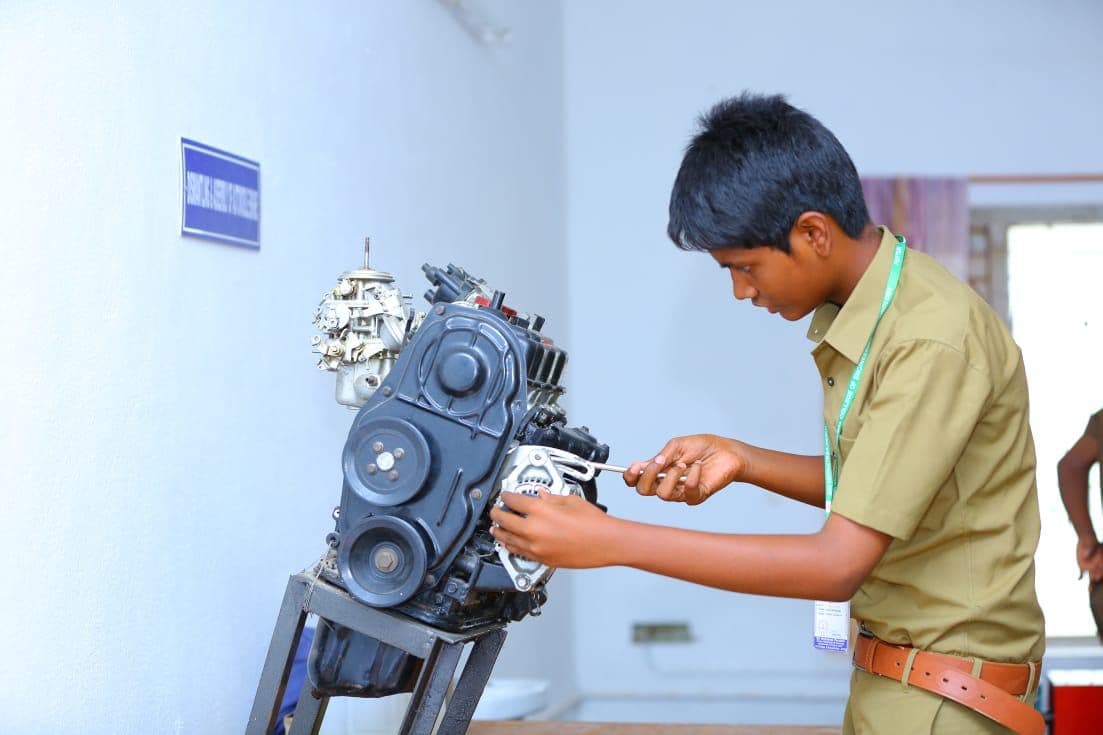
Workshops and laboratories cover thermal engineering, fluid mechanics, CAD/CAM, metrology and manufacturing processes.
Graduates pursue careers in manufacturing, automotive, energy, design and the growing automation and robotics sectors.
Vision
To become a Centre of Excellence in Mechanical Engineering Studies and Research.
Mission
- 01
Provide congenial academic ambience with necessary infrastructure and learning resources.
- 02
Inculcate confidence to face and experience new challenges from industry and society.
- 03
Ignite the students to acquire self-reliance in State-of-the-Art Technologies.
- 04
Foster enterprising spirit among students.
Programmes Offered
- Mechanical Engineering30 seats
Total sanctioned intake: 30
PEO's, PSO's & PO's
Program Educational Objectives (PEOs)
PEO1
Have professional competency through the application of knowledge gained from subjects like Mathematics, Physics, Chemistry, Inter-Disciplinary and core subjects like Manufacturing Engineering, Thermal Sciences, CAD/CAM and Design & Development. (Professional Competency)
PEO2
Excel in one's career by critical thinking towards successful services and growth of the organization or as an entrepreneur or through higher studies. (Successful Career Goals)
PEO3
Enhance knowledge by updating advanced technological concepts for facing the rapidly changing world and contribute to society through innovation and creativity. (Continuing Education and Contribution to Society)
Program Specific Outcomes (PSOs)
PSO1
Apply the knowledge obtained in core areas for the design, analysis and manufacturing of mechanical systems and processes.
PSO2
Exhibit novel concepts on product development with the help of modern CAD/CAM integration, while ensuring best manufacturing practices.
Program Outcomes (POs)
Engineering knowledge: Apply the knowledge of mathematics, science, engineering fundamentals, and an engineering specialization to the solution of complex engineering problems.
Problem analysis: Identify, formulate, review research literature, and analyze complex engineering problems reaching substantiated conclusions using first principles of mathematics, natural sciences, and engineering sciences.
Design/development of solutions: Design solutions for complex engineering problems and design system components or processes that meet the specified needs with appropriate consideration for the public health and safety, and the cultural, societal, and environmental considerations.
Conduct investigations of complex problems: Use research-based knowledge and research methods including design of experiments, analysis and interpretation of data, and synthesis of the information to provide valid conclusions.
Modern tool usage: Create, select, and apply appropriate techniques, resources, and modern engineering and IT tools including prediction and modeling to complex engineering activities with an understanding of the limitations.
The engineer and society: Apply reasoning informed by the contextual knowledge to assess societal, health, safety, legal and cultural issues and the consequent responsibilities relevant to the professional engineering practice.
Environment and sustainability: Understand the impact of the professional engineering solutions in societal and environmental contexts, and demonstrate the knowledge of, and need for sustainable development.
Ethics: Apply ethical principles and commit to professional ethics and responsibilities and norms of the engineering practice.
Individual and team work: Function effectively as an individual, and as a member or leader in diverse teams, and in multidisciplinary settings.
Communication: Communicate effectively on complex engineering activities with the engineering community and with society at large, such as, being able to comprehend and write effective reports and design documentation, make effective presentations, and give and receive clear instructions.
Project management and finance: Demonstrate knowledge and understanding of the engineering and management principles and apply these to one's own work, as a member and leader in a team, to manage projects and in multidisciplinary environments.
Life-long learning: Recognize the need for, and have the preparation and ability to engage in independent and life-long learning in the broadest context of technological change.
Regulation and Syllabus
The department follows the JNTUA outcome-based curriculum, periodically revised by the Curriculum Development Cell in line with AICTE and NBA guidelines.
Regulation documents and the detailed semester-wise syllabus are available from the department office and the college Exam Portal.
Faculty Profile
Dr. G. Naresh Kumar
Professor & Head
M.E.,Ph.D
Dr. S. L. V. Prasad
Professor
Ph.D
Dr. T. Muni Shankar
Professor
Ph.D
Dr. S. BVJ. Chandbadshah
Associate Professor
Ph.D
Mr. T. Ramachandraiah
Assistant Professor
M.Tech
Mr. M. Pradeep Kumar
Assistant Professor
M.Tech
Mr. T. Lakshmipathi
Assistant Professor
M.Tech
Mr. J. Kumar
Assistant Professor
M.Tech
Mr. U. Pichandi
Assistant Professor
M.Tech
Mr. P. Satish
Assistant Professor
M.Tech
Mr. T. Loganathan
Assistant Professor
M.Tech
Mr. R. Ramanath
Assistant Professor
M.Tech
Mr. V. Dinesh Kumar
Assistant Professor
M.Tech
Mr. M. Anandan
Assistant Professor
M.Tech
Mr. E. Rajesh
Assistant Professor
M.Tech
Mr. A. Siva Kumar
Assistant Professor
M.Tech
Mr. C. Dhatchanamoorthy
Assistant Professor
M.Tech
Mr. M. Muni Kali Pavan
Assistant Professor
M.Tech
Mr. C. Rajavardhana Reddy
Assistant Professor
M.Tech
Mrs. A. Roja
Assistant Professor
M.Tech
Miss. T. Alekhya
Assistant Professor
M.Tech
Mr. S. Yaseen
Assistant Professor
M.Tech
Course Material
Subject-wise lecture notes, lesson plans, question banks, lab manuals and model papers are curated by the faculty and shared through the department's learning portal and class repositories.
Laboratory Facilities
Thermal Engineering Lab
IC engine test rigs, calorimeters, heat-transfer apparatus and performance test setups.
Fluid Mechanics & Machinery Lab
Centrifugal and reciprocating pumps, turbines, flow-measurement and Bernoulli's apparatus.
CAD/CAM Lab
Workstations with AutoCAD, CATIA/SolidWorks, ANSYS and CNC simulation software.
Manufacturing & Workshop
Lathes, milling, drilling, welding, foundry and fitting/carpentry sections.
Metrology & Measurements Lab
Slip gauges, sine bars, comparators, profile projector and surface-finish instruments.
Research Facilities
Research is pursued in thermal, manufacturing and design domains, supported by the institutional R&D Cell.
Research Thrust Areas
Mentor Details
Each student is assigned a faculty mentor under the institutional Mentor Program, with regular guidance on academics and career planning.
Departmental Activities
- Guest lectures by industry experts
- Workshops on CAD/CAM, CNC and 3D printing
- Industrial visits to manufacturing and automotive units
- Project exhibitions and design contests
- Technical seminars and paper presentations
Professional Bodies
Department Library
A dedicated departmental library supplements the central library with titles, reference volumes, previous question papers, project reports and subscriptions to technical journals for ready student and faculty access.
Career outcomes are supported by the campus-wide Training & Placement Cell — explore placements →