

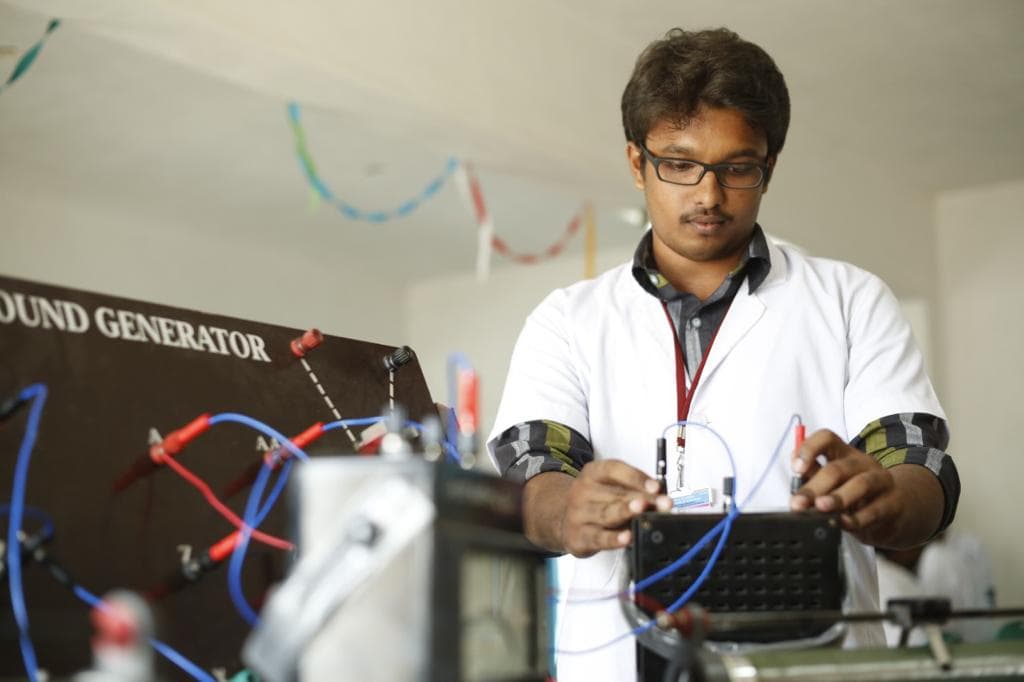
M.Tech — Embedded Systems
Specialised mastery of embedded and IoT systems.
M.Tech ES
Programme
18 seats
Sanctioned Intake
Embedded · RTOS · IoT
Focus
Coursework + dissertation
Mode
About the Department
The M.Tech in Embedded Systems develops deep expertise in microcontrollers, real-time operating systems, IoT and embedded software design.
Laboratory work and dissertation projects connect to live problems in automotive, consumer electronics and industrial automation.
Graduates pursue embedded-engineering and R&D roles in core electronics companies.
Vision
To create specialists in embedded and real-time systems for industry and research.
Mission
- 01
Provide advanced study of embedded architectures, RTOS and IoT.
- 02
Develop hands-on capability in firmware and system design.
- 03
Promote applied research and industry-relevant dissertation work.
Programmes Offered
- M.Tech — Embedded Systems18 seats
Total sanctioned intake: 18
PEO's, PSO's & PO's
Program Educational Objectives (PEOs)
PEO1
Attain advanced competency in embedded and real-time system design. (Professional Competency)
PEO2
Excel as embedded engineers, researchers or R&D specialists in core electronics. (Successful Career Goals)
PEO3
Adapt to evolving embedded and IoT technologies and contribute through innovation. (Continuing Education and Contribution to Society)
Program Specific Outcomes (PSOs)
PSO1
Design and implement embedded hardware and firmware for real-time and IoT applications.
PSO2
Apply RTOS, system modelling and optimisation to build reliable embedded solutions.
Program Outcomes (POs)
Engineering knowledge: Apply the knowledge of mathematics, science, engineering fundamentals, and an engineering specialization to the solution of complex engineering problems.
Problem analysis: Identify, formulate, review research literature, and analyze complex engineering problems reaching substantiated conclusions using first principles of mathematics, natural sciences, and engineering sciences.
Design/development of solutions: Design solutions for complex engineering problems and design system components or processes that meet the specified needs with appropriate consideration for the public health and safety, and the cultural, societal, and environmental considerations.
Conduct investigations of complex problems: Use research-based knowledge and research methods including design of experiments, analysis and interpretation of data, and synthesis of the information to provide valid conclusions.
Modern tool usage: Create, select, and apply appropriate techniques, resources, and modern engineering and IT tools including prediction and modeling to complex engineering activities with an understanding of the limitations.
The engineer and society: Apply reasoning informed by the contextual knowledge to assess societal, health, safety, legal and cultural issues and the consequent responsibilities relevant to the professional engineering practice.
Environment and sustainability: Understand the impact of the professional engineering solutions in societal and environmental contexts, and demonstrate the knowledge of, and need for sustainable development.
Ethics: Apply ethical principles and commit to professional ethics and responsibilities and norms of the engineering practice.
Individual and team work: Function effectively as an individual, and as a member or leader in diverse teams, and in multidisciplinary settings.
Communication: Communicate effectively on complex engineering activities with the engineering community and with society at large, such as, being able to comprehend and write effective reports and design documentation, make effective presentations, and give and receive clear instructions.
Project management and finance: Demonstrate knowledge and understanding of the engineering and management principles and apply these to one's own work, as a member and leader in a team, to manage projects and in multidisciplinary environments.
Life-long learning: Recognize the need for, and have the preparation and ability to engage in independent and life-long learning in the broadest context of technological change.
Regulation and Syllabus
A two-year programme of advanced coursework and a research dissertation under the JNTUA postgraduate regulation, periodically revised by the Curriculum Development Cell.
Regulation documents and the detailed semester-wise syllabus are available from the department office and the college Exam Portal.
Faculty Profile
Dr. S. VenkataKiran
Programme Coordinator (HOD, ECE)
Ph.D
Dr. K. Murali Babu
Professor
Ph.D
Dr. A. Gokul Chandhar
Associate Professor
Ph.D
Dr. R. SenthamilSelvan
Associate Professor
Ph.D
Course Material
Subject-wise lecture notes, lesson plans, question banks, lab manuals and model papers are curated by the faculty and shared through the department's learning portal and class repositories.
Laboratory Facilities
Embedded Systems Research Lab
18 systemsARM Cortex development boards, RTOS toolchains, debuggers and logic analysers.
IoT & Sensors Lab
12 systemsIoT gateways, sensor networks, wireless modules and cloud-integration platforms.
Research Facilities
The programme emphasises applied research in embedded and IoT systems, supported by the institutional R&D Cell.
Research Thrust Areas
Mentor Details
Each scholar is guided by a faculty research mentor through coursework and an industry-relevant dissertation.
Departmental Activities
- Research seminars on embedded and IoT systems
- Hands-on RTOS and firmware workshops
- Conference participation and paper presentations
- Dissertation progress reviews
Professional Bodies
Department Library
A dedicated departmental library supplements the central library with titles, reference volumes, previous question papers, project reports and subscriptions to technical journals for ready student and faculty access.
Career outcomes are supported by the campus-wide Training & Placement Cell — explore placements →