
Electrical & Electronics Engineering
Powering industry — generation, control and clean energy.
EEE
Programme
60 seats
Sanctioned Intake
Power · Drives · Renewables
Focus
Founding department
Heritage
About the Department
The Department of Electrical & Electronics Engineering equips students to design, operate and maintain power and automation systems across industry.
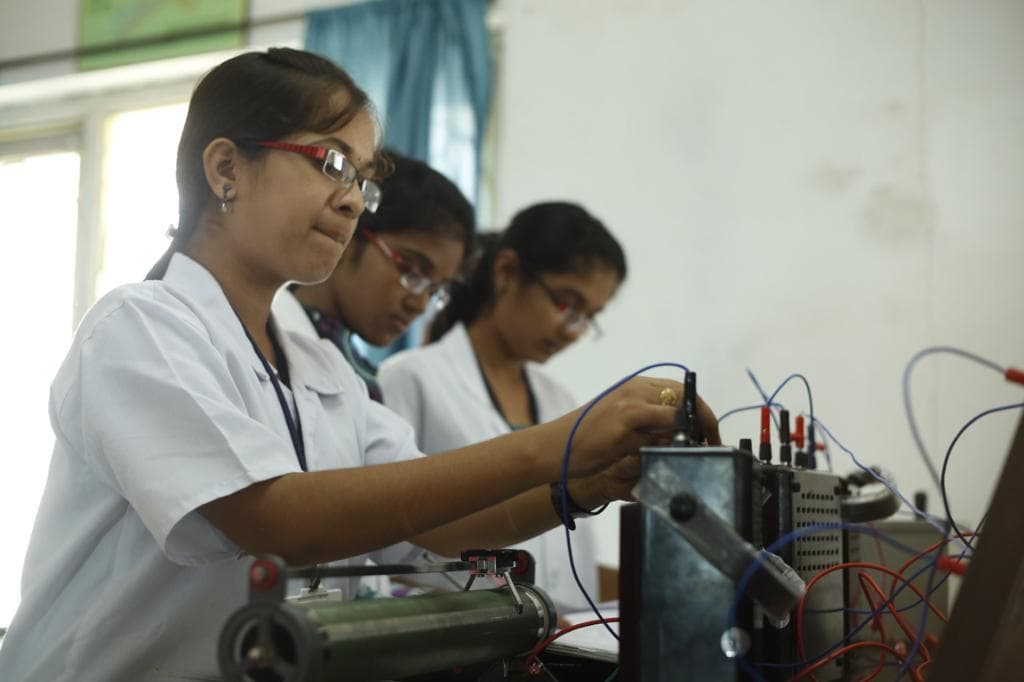
Laboratories span electrical machines, power systems, power electronics, control systems and renewable energy, reflecting the sector's shift toward clean power.
Graduates find roles across power utilities, manufacturing, automation, electric mobility and the renewable-energy sector.
Vision
The vision of the Electrical & Electronics Engineering Department is dedicated to curving the youth as dynamic, competent, valued and knowledgeable professionals who shall lead the nation to a better future.
Mission
- 01
Providing quality education, student-centred teaching–learning process and state-of-art infrastructure for professional aspirants hailing from both rural and urban areas.
- 02
Imparting technical education that encourages independent thinking, develops strong domain of knowledge, hones contemporary skills and positive attitudes towards holistic growth of young minds.
- 03
Evolving the department into a centre of academic and research excellence.
Programmes Offered
- Electrical & Electronics Engineering60 seats
Total sanctioned intake: 60
PEO's, PSO's & PO's
Program Educational Objectives (PEOs)
PEO1
To prepare students for higher education and successful career in industry meeting the needs of National and Multinational companies in the field of Electrical & Electronics Engineering.
PEO2
To develop the ability among students in solving engineering problems & motivate towards R&D in the areas of Power Systems and Power Electronics.
PEO3
To demonstrate the art of excellence in developing the effective communication skills of the students in English medium and improve their personality.
PEO4
To promote awareness among students for lifelong learning and development with professional ethics.
Program Specific Outcomes (PSOs)
PSO1
Circuit Analysis and Design: Graduates will demonstrate proficiency in analyzing electrical circuits and designing power electronic systems, applying principles of circuit theory to solve real-world engineering problems.
PSO2
Systems Integration Proficiency: Graduates demonstrate mastery in power system analysis, design, and optimization, implementing control systems to ensure industrial reliability while addressing energy efficiency, renewable integration, and power quality across generation, transmission, and distribution, thus shaping a sustainable energy future.
Program Outcomes (POs)
Engineering knowledge: Apply the knowledge of mathematics, science, engineering fundamentals, and an engineering specialization to the solution of complex engineering problems.
Problem analysis: Identify, formulate, review research literature, and analyze complex engineering problems reaching substantiated conclusions using first principles of mathematics, natural sciences, and engineering sciences.
Design/development of solutions: Design solutions for complex engineering problems and design system components or processes that meet the specified needs with appropriate consideration for the public health and safety, and the cultural, societal, and environmental considerations.
Conduct investigations of complex problems: Use research-based knowledge and research methods including design of experiments, analysis and interpretation of data, and synthesis of the information to provide valid conclusions.
Modern tool usage: Create, select, and apply appropriate techniques, resources, and modern engineering and IT tools including prediction and modeling to complex engineering activities with an understanding of the limitations.
The engineer and society: Apply reasoning informed by the contextual knowledge to assess societal, health, safety, legal and cultural issues and the consequent responsibilities relevant to the professional engineering practice.
Environment and sustainability: Understand the impact of the professional engineering solutions in societal and environmental contexts, and demonstrate the knowledge of, and need for sustainable development.
Ethics: Apply ethical principles and commit to professional ethics and responsibilities and norms of the engineering practice.
Individual and team work: Function effectively as an individual, and as a member or leader in diverse teams, and in multidisciplinary settings.
Communication: Communicate effectively on complex engineering activities with the engineering community and with society at large, such as, being able to comprehend and write effective reports and design documentation, make effective presentations, and give and receive clear instructions.
Project management and finance: Demonstrate knowledge and understanding of the engineering and management principles and apply these to one's own work, as a member and leader in a team, to manage projects and in multidisciplinary environments.
Life-long learning: Recognize the need for, and have the preparation and ability to engage in independent and life-long learning in the broadest context of technological change.
Regulation and Syllabus
The department follows the JNTUA outcome-based curriculum, periodically revised by the Curriculum Development Cell in line with AICTE and NBA guidelines.
Regulation documents and the detailed semester-wise syllabus are available from the department office and the college Exam Portal.
Faculty Profile
K. Siva Kumar
Professor & HOD
Dr. G. Sreenivasan
Professor
Dr. G. Sheshadri
Professor
Dr. G. Sabarinath
Professor
Mr. M. Lokanadham
Associate Professor
Mr. K. Venkatapathi
Associate Professor
Mr. S. Munisekhar
Associate Professor
Mr. K. Kiran
Assistant Professor
Mr. J. Nagaraju
Assistant Professor
Mr. K. Janardhan
Assistant Professor
Mr. A. Naveen Kumar
Assistant Professor
Mr. M. Harish
Assistant Professor
Mr. A. Rajesh
Assistant Professor
Mr. D. Mohan
Assistant Professor
Mr. K. Rajesh
Assistant Professor
Ms. N. Sushmitha
Assistant Professor
Ms. P. Geetha
Assistant Professor
Mr. T. Pavan Kumar
Assistant Professor
Mr. K. Suresh
Assistant Professor
Mr. K. C. Satheesh Kumar
Assistant Professor
Course Material
Subject-wise lecture notes, lesson plans, question banks, lab manuals and model papers are curated by the faculty and shared through the department's learning portal and class repositories.
Laboratory Facilities
EEE Lab-1 — Electrical Machines Laboratory-I
DC Compound Motor, DC Shunt Motor, DC Series Motor coupled with DC Series Generator, DC Shunt Motor Generator Set, DC Shunt Motor coupled Compound DC Generator Set, load banks, ammeters, voltmeters, wattmeters and resistive loads.
EEE Lab-2 — Power Electronics Lab
CRO, RPS, AC Voltage Controller kit, single-phase half- and fully-controlled bridge rectifier kits, forced commutation kit, DC Jones chopper, cyclo-converter, series and parallel inverters, dual converter, single-phase firing unit, step-down transformer, SCR/MOSFET/IGBT characteristics and gate firing circuit.
EEE Lab-3 — Electrical Machines Laboratory-II
3-phase & 1-phase squirrel cage motors, 3-phase auto transformer, 3-phase synchronous motor, 3-phase alternator, slip-ring induction motor, resistive load bank, single- and three-phase transformers, variable resistance box and direct-on-line starter.
EEE Lab-4 — Control Systems & Simulation Laboratory
Function generator, synchro test panel, second-order system, temperature controller, PLC simulator software, magnetic amplifier setup, DC motor transfer function, PID controller, lead-lag compensator and MATLAB software.
EEE Lab-5 — Measurements & Instrumentation Laboratory
Phantom load setup, dynamometer power-factor meter, Kelvin's double bridge, Schering bridge, Anderson bridge, single-phase wattmeter, LPF wattmeter, two-wattmeter 3-phase power measurement, optical bench, HT dielectric oil testing kit, LVDT, capacitance pickup, strain-gauge setup and transformer turns-ratio setup.
EEE Lab-6 — Power System Lab
Over-voltage relay, over-current relay, fault simulator panel, 3-phase source panel, fault analysis simulator, negative-sequence relay, static over- & under-voltage relay, ammeter and voltmeter.
EEE Lab-7 — Electrical Circuits Lab
RPS, CRO, multimeter, breadboard, function generator, pulse generator, decade resistance/inductance/capacitance boxes and Thevenin's, Norton's, superposition, reciprocity and Z-Y parameter kits.
Research Facilities
The department promotes research in power and energy systems through the institutional R&D Cell, encouraging publications and funded projects.
Research Thrust Areas
Mentor Details
Students are mentored under the institutional Mentor Program, with faculty mentors monitoring academics, attendance and personal growth each semester.
Departmental Activities
- Guest lectures on power and energy systems
- Workshops on MATLAB, PLC and renewable technologies
- Industrial visits to substations and power plants
- Technical contests and project exhibitions
- Paper presentations and seminars
Professional Bodies
Department Library
A dedicated departmental library supplements the central library with titles, reference volumes, previous question papers, project reports and subscriptions to technical journals for ready student and faculty access.
Career outcomes are supported by the campus-wide Training & Placement Cell — explore placements →